




















The climate in our state for special education is shifting, and so is our approach to special education at Thomas Worthington. For better or for worse, this shifting climate could redefine how Special Education students are advancing in our society and in our school.
Celeste Preisse, a school counselor at TWHS, has 12 years of experience with Special Education students. She is responsible for many different aspects of Special Education, such as recommending accommodations and providing mental health services to the students. Likewise, she is seeing major changes at the district and state level. For example, the change to move away from inclusion classes, which was recommended by the district in order to give more support for specific subjects, like algebra 1.
“This is my 12th year at the district, so I have seen quite a few changes.” Preisse explained. “We used to have an English, Math, History, and Science class that we called direct classes. For students that really struggle academically, it’s taught at a lower level to support their needs. Then we would move those students to ‘Inclusion’, which means a co-taught classroom for history and science… It’s being taught kind of at the same level.”
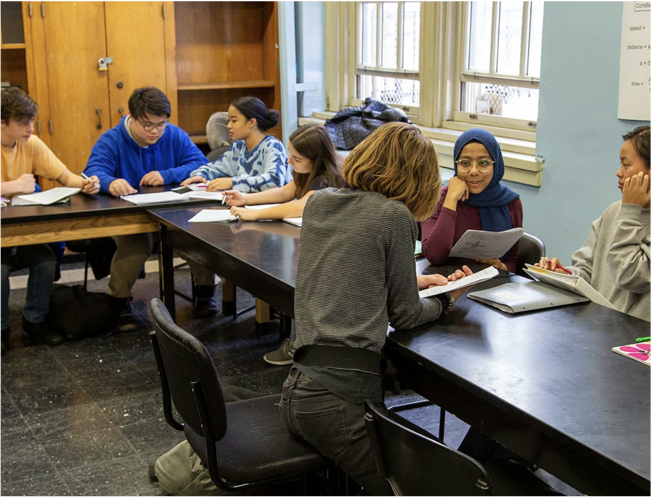
Inclusion classes are meant to help students with disabilities learn to communicate and work with their peers in a constructive manner while also accessing the classroom material. However, now that the district wants to move away from this method, the special education department is taking a different approach.
“Most recently, the district has moved away from inclusion classes,” Preisse stated. “Now this year, all students take algebra 1, and then if a student qualifies for math support through their IEP, they have an algebra 1 extension class.”
However, is this change really helping students as much as originally hoped? Preisse thinks that more inclusion was better for the accommodated students, but also explained that the reason the district was moving towards this method was because of an audit that was done at the school during the 2023-2024 school year which was initiated by the teacher’s union, The Worthington Education Association.
”I think that extension teachers are awesome,” Preisse stated. “I think they probably help a lot. I would be curious to hear what the teachers would think, because, in my mind, I feel like the more inclusion, the better. But we had this big special education audit that recommended that we move away from the inclusion model so students could get more focused attention.”
The special education audit, which aimed to improve the workload of special education staff in a cost effective manner, had 5 key areas of focus that the district aimed to improve on. Instructional coaching for special education teachers was among the top priorities, to help foster teacher confidence and capabilities to better meet the needs of disabled students. The audit was done during the 2023-2024 school year, and has changed a lot of how we view special education at our school.
The special education crowd has certainly grown, with over 16% of students having some sort of disability that required accommodations (www.OCECD.org), especially the student population with 504 plans.
“The biggest growth that I’ve seen is in 504 plans,” said Preisse. “So if a student doesn’t need specialized instruction through an IEP, they qualify for a 504 plan. That is what has impacted me the most, because I’m responsible for writing 504 plans. Doctors will tell students, if they have a diagnosis, to get a 504 plan. That isn’t wrong, it’s just overwhelming.”
According to Preisse, the state has mandated different graduation requirements for students, and that has made it harder for Special Education students to graduate.
“When I first started here, we had the Ohio State graduation tests that all students would take during their 10th grade year, and since then, we have moved to the current graduation requirements (Source), which I feel can be limiting for some students, because you have to earn a certain score on your end of course exams to demonstrate competency,” Preisse explained. “Oftentimes, our special education students don’t get that score. They can be exempted from competency if it aligns with their IEP goals… So it’s nice to have that benefit.”
In spite of these complicated issues, Mrs. Preisse still loves her job and cherishes every student.
“I love my job because every day is different. And I love getting to work with students at such an important time in their life,” she explained. ”I just think high school is really hard in so many ways, but really rewarding in so many ways, And I love being able to help students on that journey. And I just think we have amazing staff here, and I love my department, so I really love what I do.”